
For a lot of families, it starts with a suggestion from a therapist, a video from a friend, or a late-night search for “horse riding for autism near me.” Then come the practical questions. Will my child tolerate the helmet? What if the arena is too loud? Is this a therapy, or a riding lesson? And does it actually help?
Rhythms of Grace is a volunteer-driven nonprofit in Dallas Center, Iowa, just west of Des Moines, offering equine-assisted services to children and adults with disabilities and special needs, including people on the autism spectrum. This guide answers the questions families ask us most, explains what the research says, and covers how to get started and pay for sessions.
What is adaptive riding for autistic children?
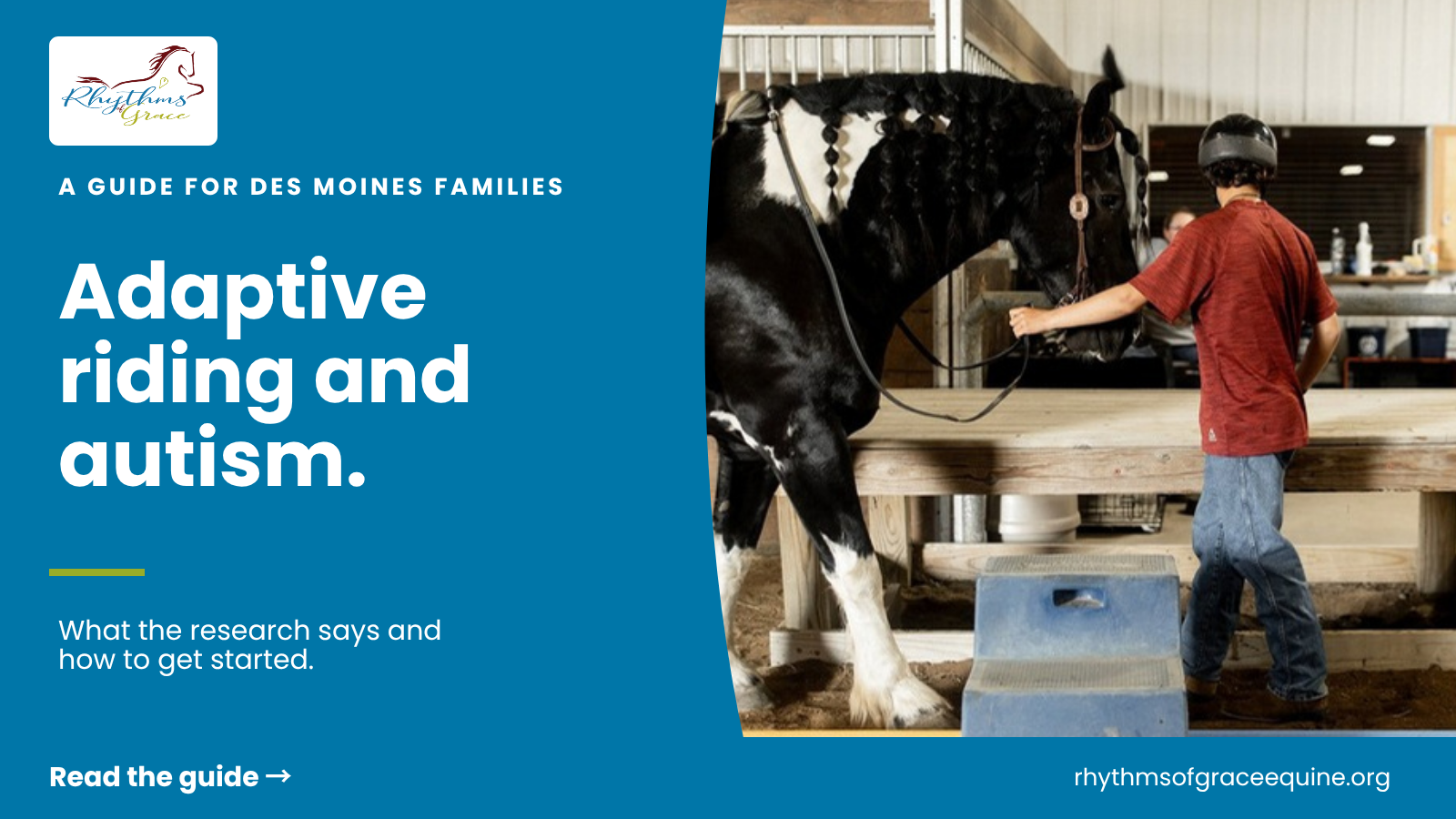
Adaptive riding, also called therapeutic riding, is a riding lesson adapted to the rider. At Rhythms of Grace, lessons are taught by PATH Intl. Certified Therapeutic Riding Instructors, and each rider follows a customized lesson plan. A trained volunteer team may lead the horse and walk alongside the rider as sidewalkers.
Riders work on riding and horsemanship skills, and the lesson is built around them: their goals, their pace, and what helps them feel settled. Along the way, riders practice independence, safety awareness, decision-making, and skills that carry into daily life.
Adaptive riding is horsemanship, not therapy. If your child’s care team is recommending therapy that incorporates horses, that is a different service, led by a licensed professional. At Rhythms of Grace, occupational therapy is provided by licensed therapists who may use the horse’s movement or the barn environment as part of an individualized plan of care. Our guide to equine-assisted services near Des Moines explains the difference in more detail.
Does horseback riding help children with autism?
The research is encouraging, though still growing. The best-known study is a randomized trial led by Robin Gabriels at the University of Colorado Anschutz Medical Campus. It enrolled 127 children and teens ages 6 to 16. Half took part in 10 weeks of therapeutic horseback riding, and half took part in barn activities with no direct horse contact. Compared with the barn group, the riding group showed significant improvements in irritability, hyperactivity, social cognition, social communication, and the number of words spoken, with gains in irritability and hyperactivity starting by week 5 (Gabriels et al., 2015).
The same team followed up six months later with the families who returned. Gains in social and communication skills held up within the riding group, and the improvement in irritability partly held, while the improvement in hyperactivity did not last. Only about half of the original participants came back for the follow-up, so the authors were careful about how far the results can be generalized (Gabriels et al., 2018).
Adaptive riding works alongside the other supports your child already relies on. For many families, it becomes one part of a broader plan.
What should I look for in a program for my autistic child?
Start with who leads the session. Riding instructors should hold PATH Intl. certification, and any therapy should be provided by a licensed professional. Rhythms of Grace has been a PATH Intl. Member Center since 2020 (Candid).
Then think about your child’s sensory needs. Ask what the arena sounds like during a lesson, where you’ll wait, and whether there’s a quieter space if your child needs a break. Our lessons take place in a natural setting at River Heights Ranch, with indoor and outdoor arenas and a wheelchair-accessible barn with a viewing area for families.
It also helps to ask about consistency. If routine matters to your child, ask whether your child can keep the same day, time, and team from week to week. Finally, ask how the horses are chosen and cared for. A calm, well-cared-for horse is part of what makes a lesson safe.
How do we get started at Rhythms of Grace?
Programs run in six-week sessions in the spring, summer, and fall. Adaptive riding and equine-assisted learning are offered on Tuesdays, Wednesdays, and Saturdays, and occupational therapy on Tuesdays and Thursdays. To apply, visit our Programs page and submit:
A Client Annual Application
A Session Registration Form
An Annual Physician’s Release, due before the first session of the year
The application, registration, and payment are due four weeks before each session. Requested times aren’t guaranteed, and if your child is placed on a waitlist, we’ll refund your payment or apply it to the next session.
How can families pay for adaptive riding?
Our lessons are highly subsidized, and tuition is due before each session. Rhythms of Grace doesn’t bill insurance directly or receive insurance reimbursements. If cost is a barrier, you can request a Rhythms of Grace financial need scholarship on our Programs page.
Iowa families may also qualify for outside help. The Autism Society of Iowa offers family scholarships, and Children at Home is another resource to explore. Both accept applications year-round, and it’s best to apply at least six weeks before our payment deadlines.
How can I help a child ride who couldn’t otherwise afford it?
Families of autistic children are often already paying for several therapies and services. A gift to our rider scholarship fund helps close the gap so cost doesn’t decide who gets to ride. You can give to rider scholarships here. Rhythms of Grace is a 501(c)(3) nonprofit, and gifts are tax-deductible as allowed by law.
Frequently asked questions
What age can my child start adaptive riding?
Our services are open to children and adults. Contact us about your child’s age and needs, and we can talk through whether a session is a good fit.
Do adults on the autism spectrum ride too?
Yes. Rhythms of Grace serves children and adults with physical, cognitive, sensory, learning, social, or emotional needs.
Is adaptive riding the same as hippotherapy?
No. Adaptive riding is a riding lesson taught by a certified instructor. Hippotherapy describes how licensed occupational, physical, or speech therapists use the horse’s movement as a treatment tool within their own therapy services (American Hippotherapy Association).
Where is Rhythms of Grace?
We’re at River Heights Ranch, 23625 River Heights Drive, Dallas Center, Iowa 50063, west of Des Moines. Email Info@RhythmsofGraceEquine.org or call (515) 305-7361 with questions.
