
Equine Therapy Near Des Moines: Riding Lesson or Therapy Session?
If you’ve typed “equine therapy near me” into a search bar around Des Moines, you’ve probably run into a tangle of terms: therapeutic riding, adaptive riding, hippotherapy, equine-assisted therapy. They all involve horses. They aren’t the same thing, and the professionals who provide these services have worked to agree on clearer language for them.
At Rhythms of Grace, families standing at the arena rail for the first time often ask us some version of the same question: is this a riding lesson or a therapy session? The honest answer depends on who is leading the session and what the person in the saddle, or on the ground, is working toward. This guide walks through the difference, what to look for in any program, and how to get started with us at River Heights Ranch in Dallas Center, just west of Des Moines.
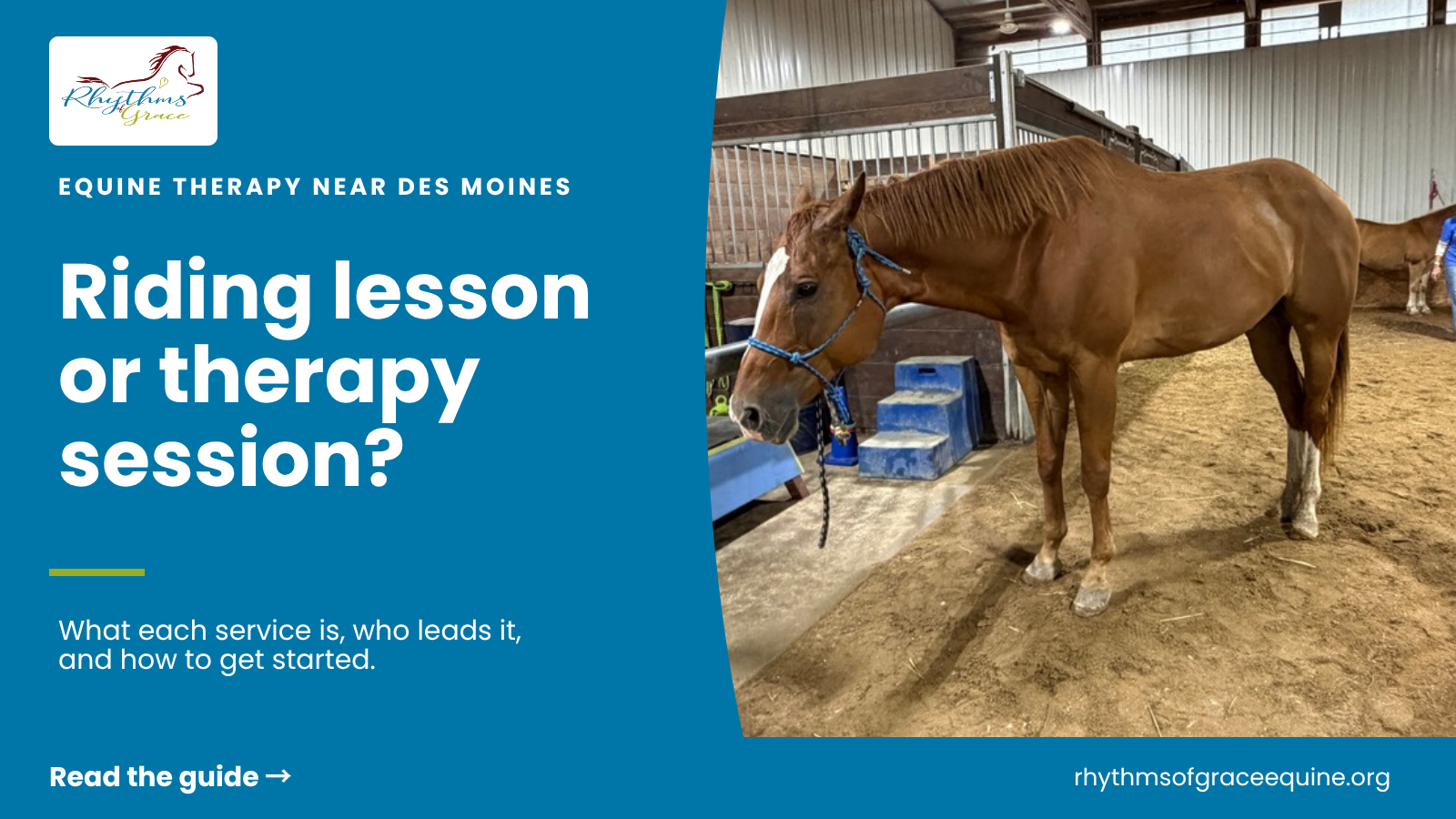
One horse, different kinds of work
Picture two sessions in the same arena on the same Tuesday. In the first, a rider is learning to steer her horse through a line of cones while a volunteer leads and two sidewalkers walk beside her. In the second, a child sits on the same horse while a licensed occupational therapist adjusts his position and asks the horse to walk, halt, and turn, watching how his body responds. From the viewing area, the two sessions look alike. Their purpose is completely different.
PATH International and other leaders in the field use equine-assisted services as the unifying term for this work. It includes three distinct kinds of services: therapy, learning, and horsemanship (PATH Intl. Optimal Terminology). PATH Intl. does not use “equine therapy” to describe these services, in part because the phrase suggests the horse is the one receiving therapy (PATH Intl.). Two questions help sort it out: what is the person working on, and who is leading the session?
Horsemanship: adaptive or therapeutic riding
Adaptive riding, also called therapeutic riding, is a riding lesson. PATH Intl. treats the two names as interchangeable, and it is one of the horsemanship services within equine-assisted services, alongside adaptive equestrian sports, driving, and interactive vaulting. At Rhythms of Grace, lessons are taught by PATH Intl. Certified Therapeutic Riding Instructors, and each rider follows a customized lesson plan.
Riders work on riding and horsemanship skills, and along the way they build independence, safety awareness, and decision-making, along with cognitive, physical, emotional, and social skills that carry into everyday life. Depending on the rider, a trained volunteer team may lead the horse and walk alongside as sidewalkers. The benefits can be real and lasting, but adaptive riding is instruction, not therapy, and the term shouldn’t be used for every service that involves horses.
Therapy: occupational therapy and hippotherapy
In the therapy category, a licensed professional incorporates horses into their own discipline, within its scope of practice. Hippotherapy isn’t a riding lesson, and according to the American Hippotherapy Association, it isn’t a separate program either. It describes how occupational therapists, physical therapists, and speech-language pathologists purposefully use the horse’s movement as a treatment tool to work toward sensory, motor, and cognitive goals (American Hippotherapy Association). The rider isn’t there to learn to ride. The therapist sets the goals, guides each session, and decides how the horse is involved.
At Rhythms of Grace, occupational therapy is provided by licensed therapists who may use the horse’s movement or the equine environment as part of an individualized plan of care. A horse alone doesn’t make an activity therapy; the licensed professional and the plan of care do.
Therapy: counseling and psychotherapy incorporating horses
Some of the most meaningful work at the barn happens with both feet on the ground. Counseling or psychotherapy incorporating interactions with horses is mental health care delivered by a licensed mental health professional, with horses as part of the process. Rhythms of Grace added mental health services in 2024, partnering with licensed therapists who work alongside our credentialed equine professionals and offer trauma-informed care (Candid).
Learning: equine-assisted learning
Equine-assisted learning is the third category. It uses structured activities with horses to build skills such as communication, trust, respect, and teamwork. It is led by specially trained or certified professionals, and it isn’t counseling or psychotherapy. Utah State University Extension’s guide to equine-assisted services is a helpful, plain-language overview of these differences and the professional roles involved.
A quick way to tell them apart
Horsemanship (adaptive or therapeutic riding): led by a certified riding instructor; the goal is riding and horsemanship skills.
Therapy (occupational, physical, or speech therapy using hippotherapy): led by a licensed therapist; goals come from a plan of care.
Therapy (counseling or psychotherapy incorporating horses): led by a licensed mental health professional; goals are therapeutic.
Learning (equine-assisted learning): structured activities with horses led by trained or certified professionals; goals are learning and life skills, not therapy.
Who stands behind the work at Rhythms of Grace
Because “equine therapy” is used so loosely, credentials matter. Here is what stands behind our equine-assisted services:
A PATH Intl. Member Center. Rhythms of Grace has been affiliated with PATH International since 2020 (Candid). PATH Intl. sets standards for equine-assisted services and certifies the instructors who provide them.
Certified, experienced leadership. Our founder and CEO, Dawn Carlson, is a PATH Intl. Certified Therapeutic Riding Instructor (CTRI) and Equine Specialist in Mental Health and Learning (ESMHL). She also serves as a mentor and supervisor and is Natural Lifemanship Level 1 trained (About Rhythms of Grace).
Licensed therapists. Occupational therapy, counseling, and psychotherapy are provided by licensed professionals working within their scope of practice.
EQUUS Foundation Guardian, 2026. The EQUUS Foundation’s Guardian program focuses on transparency in the care and service of horses (EQUUS Foundation).
Candid Platinum Seal of Transparency, 2026. Platinum is the highest level Candid awards. Nonprofits earn it by sharing their goals, strategies, and how they measure results (Candid Learning).
We share these not as trophies, but because they answer the questions we hope every family will ask, of us or of any program they’re considering.
What to look for in an equine-assisted services program
Whichever service you’re exploring, a good program should be glad to answer these questions plainly:
Which service is this, and who leads it? You should know whether a session is therapy, learning, or horsemanship, and who is responsible for it.
What are the credentials? Ask whether riding instructors hold PATH Intl. certification and whether therapists are licensed.
How are volunteers trained and sessions staffed? Volunteers should learn their specific roles before they work alongside participants.
How are the horses chosen and cared for? Horse welfare matters for safety, too. For example, we don’t schedule classes in extreme summer heat to protect our horses.
Is the facility accessible? Our barn at River Heights Ranch is wheelchair accessible, with indoor and outdoor arenas and a comfortable viewing area for families.
What does it cost, and is help available? Ask about tuition, insurance, and scholarships up front.
How to get started at Rhythms of Grace
Our equine-assisted services are open to children and adults with physical, cognitive, sensory, learning, social, or emotional needs. Programs run in six-week sessions in the spring, summer, and fall:
Occupational therapy: Tuesdays and Thursdays
Adaptive riding and equine-assisted learning: Tuesdays, Wednesdays, and Saturdays
Counseling and psychotherapy: scheduled privately
To apply, visit our Programs page and submit:
A Client Annual Application
A Session Registration Form
An Annual Physician’s Release, due before your first session of the year
The application, registration, and payment are due four weeks before each session. Rhythms of Grace is volunteer-driven with no employees, so paperwork and payment need to be in on time to be considered for scheduling. Requested times aren’t guaranteed; if you’re placed on a waitlist, we’ll refund your payment or apply it to the next session.
Cost and financial help
Tuition is due before each session. Rhythms of Grace does not bill insurance directly or receive insurance reimbursements. If cost is a barrier, you can request a Rhythms of Grace financial need scholarship on our Programs page. Families may also look into outside resources such as Children at Home, Autism Society of Iowa family scholarships, and Beau’s Beautiful Blessings. These accept applications year-round; it’s best to apply at least six weeks before our payment deadlines.
Questions? We’re glad to help
Not sure which service fits? Email us at Info@RhythmsofGraceEquine.org or call (515) 305-7361. We make our home at River Heights Ranch, 23625 River Heights Drive, Dallas Center, Iowa. Please arrange visits with our team so we can respect program schedules and participant privacy.
Know a family who’s been searching for “equine therapy” near Des Moines? Share this guide with them.
